|
|
| . |
Measurement-based Feedforward Tuning:
|
||||||
|
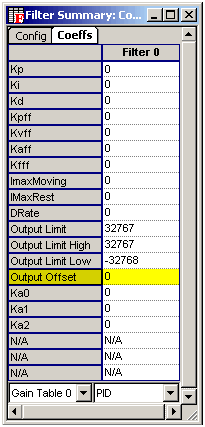
Use the torque value that brings motion to a rest after first exceeding breakaway torque for determining friction feedforward and output offset.
|
What is a small amount of motion?
A "small amount of motion" differs from system to system, but in general
you want to make a move that overcomes the mechanical hysteresis in a
system (lip seals, oil films, etc.). In the face of these forces, it is
common to put a small offset that results in only a few counts of motion.
From that point, a significant increase in output offset is required to
be able to visually see more of a continuous motion. This is because some
of the parts that contribute friction are flexible and will move a bit
with little force until they "take a set" — where they will require
more force for further motion to occur. You will likely not want to use
the value that gets the stage to move 1 or 2 encoder counts because this
amount of movement is often highly non-linear and dependent on behaviors
of individual bearings and seals. A larger movement will not be as drastically
affected by these effects. When "a small amount of motion" is referred
to above, consider this to be the amount of motion where everything has
"taken a set" and the stage is ready to continue to move very slowly as
a result of the output offset.
Friction feedforward on the XMP is calculated as follows:
Friction feedforward contribution to DAC
= commanded
velocity sign (-1, 0, or 1) * Kfff
Acceleration and friction feedforward are equally applicable to PID and PIV.
| | | Copyright © 2001-2021 Motion Engineering |